How Social Proof Can Increase Donations During Live Fundraising Events
Estimated reading time: 4 minutes
Table of contents
Fundraising is both exciting and challenging. Building relationships with supporters and seeing them become lifelong donors is incredibly rewarding. But if you’ve worked in fundraising for any length of time, you know there isn’t a formula that guarantees results. Every audience is different. Strategies that resonate with one group may not work with another.
Whether someone is deciding to buy a bag of coffee at Costco or make a charitable gift, emotion plays a much larger role than logic in decision-making. Nobel Prize-winning psychologist Daniel Kahneman explains in Thinking, Fast and Slow that our brains rely heavily on instinctive, emotional thinking when making decisions. And when people are uncertain, they often look to others for cues.
Behavioral scientist Nancy Harhut, author of Using Behavioral Science in Marketing, calls this social proof. We naturally look to see what people like us are doing and use their behavior as a guide for our own.
When it comes to live fundraising, that is a powerful advantage.
Social Proof in Action
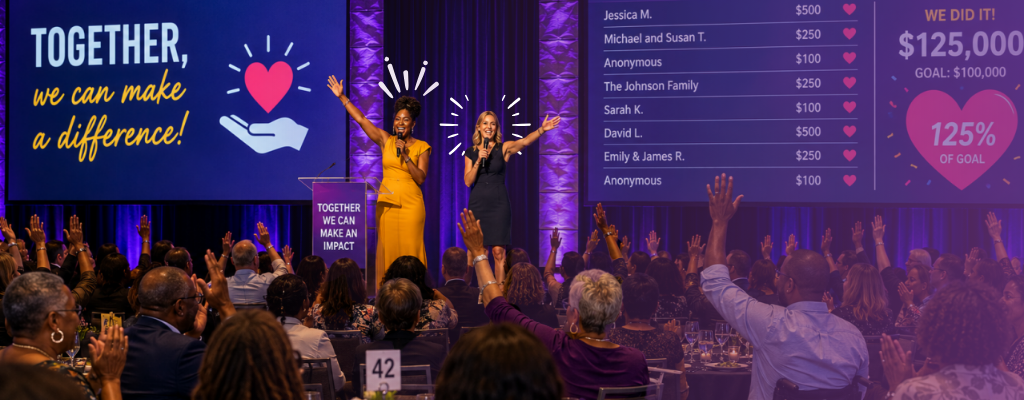
Earlier this year, I attended my sorority’s regional conference. As I sat in a large auditorium at a civic center, among my 6,000 sisters, there came a time in the program for donations to fund a worthy cause. Before the appeal even began, I had already decided I wasn’t going to give that evening. I support the organization in other ways, and I felt comfortable with that decision.
The two presenters leading the campaign were enthusiastic and passionate about their ask. They conveyed a clear goal and what the funds would be used for. And that’s important. Donors deserve to know exactly what their gifts will accomplish.
Then the appeal began.
Using GiveLively’s Live Display platform, we were invited to text a number and make a donation. As gifts came in, donor names immediately appeared across three large screens throughout the auditorium. Occasionally, the name “Anonymous” would appear. That just means some sisters opted to give anonymously. Someone in the room, possibly next to me, had just donated to the cause.
Remember, before the appeal began, I had decided that I was not, on this particular night, going to give.
So, I kept watching.
Name after name appeared.
Gift after gift rolled in.
Suddenly, I started to feel some kind of way.
A few minutes later, I pulled out my Android (yes, Android…not iPhone), made my donation, and immediately looked up to find my name on the screen. When I saw it, I had a distinct sense of pride that I was among the many who helped the cause exceed the stated goal.
Why Social Proof Works in Real-Time Fundraising
This experience illustrates why social proof is so effective.
Social proof, in general, works because it’s a hardwired human behavior, according to Harhut. The brain is going to do it automatically. Fundraisers just need to understand how to tap into it.
From a fundraising perspective, social proof validates your organization’s cause and reduces uncertainty. Seeing others donate signals that you’re supporting a cause that others deem worthy.
Social proof also creates a sense of urgency. Watching names continuously appear on a screen creates a feeling that something meaningful is happening right now and you don’t want to miss the moment. Yes, the fear of missing out (FOMO) is real.
Finally, visible donor activity helps establish giving norms. When donors aren’t sure how much to give, they often look for cues from others. Someone considering a $25 gift may decide to give $50 after seeing several gifts at that level.
Strategies for Live Fundraising Campaigns
GiveLively is one of several platforms that offer live donation displays, so this isn’t an endorsement of one tool over another. Rather, it’s an example of how behavioral science can strengthen fundraising.
Real-time donor feeds, progress bars, and leaderboards help create visible momentum. As donations increase, so does the energy in the room.
Equally important is the person leading the appeal. Technology can gamify the process, but it can’t ignite the experience. A charismatic speaker who clearly communicates the impact of the campaign while tapping into the emotion of the moment makes all the difference.
The Takeaway
We’ve all been there when the appeal comes around at a fundraising event, and people pass down their envelopes like a church collection plate. Uninspiring and typically ineffective. While fundraising is serious business, live fundraising gives nonprofits an opportunity to engage attendees in a shared experience where generosity becomes visible, contagious, and memorable. So, the next time you’re planning a fundraising event, consider how you can build momentum around the appeal.
Now that you know your attendees are hardwired to look to others when making decisions, the question isn’t whether social proof influences giving. It’s how you’ll intentionally build it into your next fundraising event.
This article originally appeared on LinkedIn. Click here to follow the author, Jacqueline Hayes, MBA, PCM.